- 27 Iulie 2026
- Achiziții
- O justiție verde pentru un mediu protejat si comunități durabile în Republica Moldova
Terms of reference for the final evaluation of the project “Green Justice for Stronger Environmental Protection and Communities in Moldova”
TERMS OF REFERENCE FOR THE FINAL EVALUATION OF THE PROJECT
“Green Justice for Stronger Environmental Protection and Communities in Moldova”
(Green Justice Steps)
Project financed by the
The Swedish International Development Cooperation Agency
SIDA Contribution no: 15217
Project title: Green Justice for Stronger Environmental Protection and Communities in Moldova
Country: Republic of Moldova
SIDA Contribution No: 15217
Project duration: September 2021- December 2026
Donor: Sweden International Development Cooperation Agency (SIDA)
Duration of assignment: 3 months (September-November 2026)
- General information
1.1 Introduction
The Green Justice Steps Project aims to improve the legal and institutional framework of environmental governance and justice and to achieve stronger involvement and cooperation of all key players in environmental protection at the national and local levels. The project reflects the aspiration of the Swedish reform cooperation Strategy for Eastern Europe for 2021-2027 to support the reform process and strengthen ties with the EU. In the long term, such an approach will contribute to environmentally and climate-resilient sustainable development and sustainable use of natural resources through better compliance of the competent state and regional authorities for implementing and enforcing environmental law in the Republic of Moldova.
The expected outcomes of the project are:
- A better understanding of the priorities for the improvement of environmental governance and justice in Moldova, communicated to and discussed with the stakeholders.
- Increased level of knowledge and improved skills of lawyers, civil society, and authorities to address the most pressing environmental problems.
- A higher level of implementation, compliance, and enforcement of environmental legislation to address the most pressing environmental problems.
- Targeted legal support on environmental cases/disputes in place, reduction of risks and consequences of environmental damage, and implementation of actions to enhance environmental governance and justice.
- A better understanding of and support for project objectives, activities, and results among the stakeholders and general public.
The expected outputs are:
- Analysis of the state of environmental governance and justice in Moldova: setting the stage for intervention and engagement conducted.
- Capacity-building of public authorities involved in the realization of environmental governance and justice in Moldova increased.
- Implementation, compliance, and enforcement of environmental legislation are ensured.
- Actions for stronger environmental governance and justice, including prevention and mitigation of environmental damage executed.
- Communication and advocacy campaigns were performed.
1.2 Evaluation object:
The evaluation object is the Final Evaluation of the Green Justice Steps Project.
The main objective of this project is to improve the legal and institutional framework of environmental governance and justice and to achieve stronger involvement and cooperation of all key players at the national and local levels.
Five specific objectives have been formulated that guide the project implementation, as follows:
- To build a strong analytical and evidential basis for setting the stage for project implementation, intervention, and engagement of the stakeholders.
- To strengthen the regulatory and institutional capacity of competent state and regional authorities to achieve higher compliance with, implement, and enforce environmental law.
- To strengthen environmental governance and justice implementation, compliance, and enforcement.
- To implement actions for stronger environmental governance and justice, including measures to prevent environmental damage and to mitigate damage if such occurs.
- To communicate the project’s objectives, activities, and results and build consensus and support for the strengthening of environmental governance and justice among the stakeholders and the public.
The overall project duration is almost six years (2021-2026).
The Mid-Term Evaluation of the project was performed at the beginning of 2024, evaluating the activities performed during the period September 2021 – December 2023.
The project is designed in a way that the project activities are on the national level and the district (local level). To achieve the objectives mentioned above, the project is working with the following target groups:
- National authorities (National Institute of Justice, General Prosecutor's Office of the Republic of Moldova, line ministries and state agencies).
- National environmental authorities (Ministry of Environment, Environmental Agency, Environmental Protection Inspectorate, Agency “Moldsilva,” National Administration “Apele Moldovei”).
- District/rayons and local public authorities – 11 target rayons.
- Non-governmental organizations, part of the Small Grants Program and the environmental NGOs community
- Academic and research institutions.
- Mass media is part of the Small Grants Program.
The Project Theory of Change suggests that the fundamental problems, such as environmental law enforcement, low awareness of citizen about their environmental rights, corruption, and lack of transparency, should be addressed coherently, and national institutions should be strengthened. At the same time, civil society and business should be the driving force of the change. Such interventions will bring a design change and increase the enforcement of liability for environmental violations, the application of regulatory guidelines, and advance the implementation of environmental agencies.
Human Rights Based Approach (HRBA) and gender mainstreaming have been integrated into the design phase, and support for women's participation is solidly integrated into the process.
EcoContact has formed a staff team to implement the Green Justice Steps Project under the project manager's leadership. Each component is coordinated by the leading expert, who is responsible for each particular component. The local staff has been employed within the target regions to support the Local Environmental component implementation.
The geographic area of the project implementation: the project is a nationally based project. Yet, under the special component related to improving local legislation enforcement, the special actions are taking place within 11 regions: mun. Bălți, rayon Cahul, Hîncești, Ialoveni, Ștefan Vodă, Căușeni, Fălesti, Călărași, Edineț, Rîșcani, Anenii Noi.
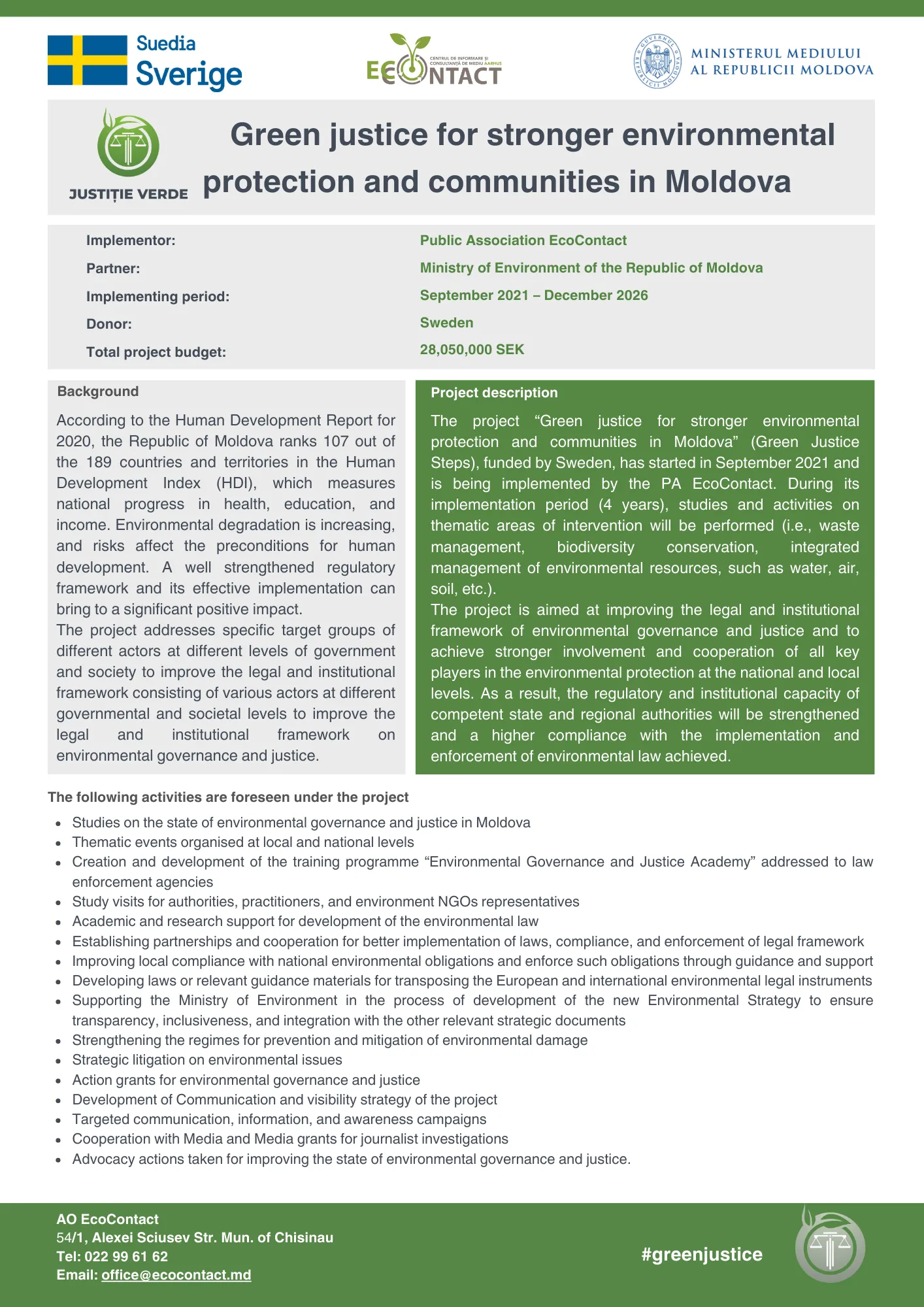
For further information, the proposal’s summary is attached as Annex B
The intervention logic or theory of change of the intervention will be further elaborated by the evaluator in the inception report.
1.3 Evaluation rationale
The final project evaluation rationale is to systematically assess an intervention's overall success upon completion. Its primary purpose is to foster accountability, document results, and extract actionable lessons for future decision-making.
- The assignment
2.1 Evaluation purpose:
The purpose or intended use of the final evaluation is to help EcoContact and the Embassy of Sweden in Chisinau to assess the major outcomes, lasting impacts, and the sustainability of the Green Justice Steps Project intervention. This final evaluation is required by the donor to assess overall performance and gather lessons learned for the upcoming Phase II scaling strategy.
The final evaluation will be used to inform both the donor and the project implementer on how project implementation performs against its original goals. It serves to measure effectiveness, improve accountability, and integrate lessons learned for future decision-making. The primary intended users of the evaluation are:
- Primary users: project implementer (project team and key partners) and the Embassy of Sweden in Chisinau (donor).
- Secondary users: Ministry of Environment and its subordinated authorities, representatives of other stakeholders involved in the project, National Institute of Justice, universities and research partners, authorities from the local platform communities, etc.
During the inception phase, the evaluator and the users will agree on who will be responsible for informing the various stakeholders about the evaluation.
2.2 Evaluation scope
The evaluation covers the " Green Justice for Stronger Environmental Protection and Communities in Moldova" project, implemented by Public Association EcoContact between 2021 and 2026 with a budget of 28 050 000 SEK.
Based on the project design and activities realized within all 5 project components, the evaluation should include the following cluster of activities:
- national-level activities
- sub-granting component (NGO and mass media)
- district-level activities in the frame of local environmental platforms and sub-grantees' impact.
The key target groups that will be covered by the final project evaluation include, but are not limited to, the following:
- National environmental authorities (i) cooperation in the process of regulatory act development and enforcement; (ii) beneficiaries of the capacity building and training component; (iii) policy and institutional reform of environmental sector aspects
- Educational and research institutions (i) studies’ drafting; (ii) capacity building and conference and academic exchange component;
- National Institute for Justice and prosecution office (i) cooperation in the process of regulatory act development and enforcement; (ii) beneficiaries of the capacity building and training component;
- NGOs (i) environmental NGO council (position papers, NGO study, forum 2025) (ii) small grant beneficiaries;
- Mass media (i) small grant beneficiaries; (ii) multipliers and dissemination of project-related information; (iii) podcast and environmental investigations.
If needed, the other target groups may be further suggested by the evaluator in the inception report.
2.3 Evaluation objective: Criteria and questions
The objective of this evaluation is to make the final evaluation of the Green Justice Steps project based on OECD/DAC criteria[1] for evaluating development assistance to determine its relevance, effectiveness, coherence, impact, and sustainability.
The evaluation questions are:
Relevance: Is the intervention doing the right thing?
- To what extent have the intervention objectives and design responded to EcoContact’s, country and the national environmental protection actor’s needs, policies, and priorities, and have they continued to do so if/when circumstances have changed?
- Which factors (internal and external) have influenced the achievement of these objectives?
- To what extent does the project contribute to the overall EU alignment process in the field of environmental protection, climate change, and sustainable management of natural resources?
Coherence: How well does the intervention fit?
- How compatible has the intervention been with other interventions in the country, sector, or organization where it is being implemented?
Effectiveness: Is the intervention achieving its objectives?
- To what extent has the intervention been achieved, or is it expected to achieve its objectives and its results, including any differential results across groups?
- Has the M&E system delivered robust and useful information that could be used to assess progress toward outcomes and contribute to learning?
Impact: What difference does the intervention make?
- To what extent has the project or programme generated, or is expected to generate, significant positive or negative, intended or unintended, high-level effects?
Sustainability: Will the benefits last?
- To what extent does the project advance the ownership of the interventions?
Additionally, the project evaluation shall assess the extent to which the implementer incorporated the following additional considerations:
- Has the project been designed and implemented in a conflict-sensitive manner?
- Has the project had any positive or negative effects on the environment? Could environment considerations have been improved in planning, implementation or follow up?
The proposed questions will be further refined during the inception phase of the evaluation.
2.4 Evaluation approach and methods
It is expected that the evaluator will describe and justify an appropriate evaluation methodology and methods for data collection in the application process, which should include, but not be limited to, a review of available documents and conducting data collection such as semi-structured interviews.
The evaluation design, methodology, and data collection and analysis methods are expected to be fully developed and presented in the inception report. It is advisable to introduce innovative and flexible approaches/methodologies and methods for remote data collection, which should be suggested when appropriate, and the risk of harm should be managed.
The evaluator should demonstrate a clear understanding of the evaluation criteria and the data collection methods. A clear distinction is to be made between evaluation methodology and methods. A gender-responsive approach/methodology, methods, tools, and data analysis techniques should be used. It is expected that the evaluators, in their tender, present i) how intended users are to participate in and contribute to the evaluation process and ii) methodology and methods for data collection that create space for reflection, discussion, and learning between the intended users of the evaluation.
In cases where sensitive or confidential issues are to be addressed in the evaluation, evaluators should ensure an evaluation design that does not put informants and stakeholders at risk during the data collection or dissemination phases. All data collected need to be disaggregated by sex.
2.5 Organisation of Evaluation Management
PA EcoContact commissions this evaluation. The intended user(s) is/are PA EcoContact, the Embassy of Sweden in Chisinau, and the key partners. It is proposed that PA EcoContact, the Embassy of Sweden in Chisinau representative, and the delegated representative of the Ministry of Environment shall participate in the start-up meeting of the evaluation. Further, the mentioned parties shall be invited for the debriefing/validation workshop where preliminary findings and conclusions are discussed. The final project evaluation outcomes will be shared with project steering committee members.
2.6 Evaluation quality
The Evaluation shall conform to OECD/DAC’s Quality Standards for Development Evaluation[2]. The evaluators shall use the Sida OECD/DAC Glossary of Key Terms in Evaluation[3] and the OECD/DAC Better Criteria for Better Evaluation[4]. The evaluators shall specify how they will handle quality assurance during the evaluation process.
2.7 Time schedule and deliverables
It is expected that the time and work plan will be presented in the tender and further detailed in the inception report. The evaluation shall be carried out in Moldova during the period September-November 2026. The timing of any visits, surveys, and interviews needs to be settled by the evaluator in dialogue with the main stakeholders during the inception phase of evaluation.
The table below lists key deliverables for the evaluation process. Alternative deadlines for deliverables may be suggested by the consultant and negotiated during the inception phase.
|
Deliverables |
Participants |
Deadlines |
|
1. Start-up meeting/s EcoContact’ s Office/ Online
|
EcoContact project team Embassy of Sweden in Chisinau Staff |
September 1-4, 2026 (tentative) |
|
2. Draft inception report |
|
September 18th, 2026 (tentative) |
|
3. Inception meeting
|
Staff of EcoContact, Embassy of Sweden in Chisinau Staff |
September 21-24th, 2026 (tentative) |
|
4. Comments from intended users to evaluators (alternatively, these may be sent to evaluators ahead of the inception meeting) |
|
September 30th, 2026 (tentative) |
|
5. Data collection, analysis, report writing and quality assurance |
Evaluators |
October 31st, 2026 (tentative) |
|
6. Debriefing/validation workshop (meeting) |
Staff of EcoContact Embassy of Sweden in Chisinau Staff Representatives of the Ministry of Environment |
November 10th 2026 (tentative) |
|
7. Draft evaluation report |
|
November 20th, 2026 |
|
8. Comments from intended users to evaluators |
|
November 25th, 2026 |
|
9. Final evaluation report[5] |
|
December 10, 2026 |
The inception report will form the basis for the continued evaluation process and shall be approved by Sida before the evaluation proceeds to implementation. The inception report should be written in English and cover evaluability issues and interpretations of evaluation questions, present the evaluation approach/methodology including how a utilization-focused and gender-responsive approach will be ensured, methods for data collection and analysis as well as the complete evaluation design, including an evaluation matrix and a stakeholder mapping/analysis. A clear distinction between the evaluation approach/methodology and methods for data collection shall be made. All limitations to the methodology and methods shall be made explicit, and the consequences of these limitations shall be discussed.
A specific time and work plan, including the number of hours/working days for each team member, should be presented as the remainder of the evaluation. The time plan shall allow space for reflection and learning between the intended users of the evaluation.
The final report shall be written in English and be professionally proofread. The final report should have a clear structure and follow the layout format of Sida’s template for decentralized evaluations (see Annex C). The executive summary should be a maximum of 3 pages.
The report shall clearly and in detail describe the evaluation approach/methodology and methods for data collection and analysis and make a clear distinction between the two. The report shall describe how the utilization-focused approach has been implemented, i.e., how intended users have participated in and contributed to the evaluation process and how methodology and methods for data collection have created space for reflection, discussion, and learning between the intended users. Furthermore, the gender-responsive approach shall be described and reflected in the findings, conclusions, and recommendations, along with other identified and relevant cross-cutting issues. Limitations to the methodology and methods and the consequences of these limitations for findings and conclusions shall be described.
Evaluation of findings shall flow logically from the data, showing a clear line of evidence to support the conclusions. Findings and analysis should substantiate conclusions. Evaluation of questions shall be clearly stated and answered in the executive summary and in the conclusions. Recommendations and lessons learned should flow logically from conclusions and be specific, directed to relevant intended users, and categorized as short-term, medium-term, and long-term.
The report should be no more than 35 pages, excluding annexes. If the methods section is extensive, it could be placed in an annex to the report. Annexes shall always include the Terms of Reference, the Inception Report, the stakeholder mapping/analysis, and the Evaluation Matrix. Lists of key informants/interviewees shall only include personal data if deemed relevant (i.e., when it is contributing to the credibility of the evaluation) based on a case-based assessment by the evaluator and the commissioning unit/embassy. Including personal data in the report must always be based on written consent.
The evaluator shall adhere to the Sida OECD/DAC Glossary of Key Terms in Evaluation[6].
2.8 Evaluation team qualification and requirements for the Bidder
General Qualification of the bidders:
- Bidders must not have been involved in the design or implementation of the project being evaluated.
- The bidder should be a legally registered company, with at least 5 years of similar experience, with proven financial records.
- At least 5 years of experience in evaluating projects in the sphere of sustainable development, legal improvements and environmental protection and proven experience in qualitative data collection and analysis.
- Experience in evaluating projects implemented in the Republic of Moldova would be an advantage.
- Previous experience in evaluations conducted for SIDA.
Proven experience in evaluating environmental or/and justice projects.
Qualification and skills of the team of experts proposed by the Bidder
Senior evaluator (team leader):
The Senior Consultant should be assigned to lead the process. He/she should be supported at least by one Environmental/ Good Governance Consultant.
Mandatory Competencies for the Senior Consultant
- University degree (BA+MA) or equivalent background in law, environmental sciences, biology, chemistry, economy or other relevant disciplines
- Specialized training in evaluation and project management (confirmed by certificates)
- At least three evaluations conducted as team leaders during the last five years within the CEE region
- At least one evaluation conducted in the capacity of the team/lead consultant
- Excellent knowledge of English
Mandatory competencies for the National Environmental Consultant
- Academic background (BA+MA)) in environmental sciences
- Strong knowledge of environmental and legal aspects in the Republic of Moldova
- At least five years of proven progressive experience in working with the national authorities of the Republic of Moldova
- Proven experience in developing environmental status reports, analytical papers, etc.
- Knowledge and experience of at least 2 years working with local authorities of the Republic of Moldova
The Bidder should propose non-key experts, considering the need for additional support and expertise required to perform the given assignment. Special attention should be paid to quality assurance.
Specifications for the Submission of Offers
The offer should include the following:
- Technical proposal (description of approach and methodology (a narrative part - 3 pages), including the evaluation schedule and evaluator’s mission schedule – up to 5 pages);
- CVs of the experts.
- Links to the evaluation reports in English from previous assignments/contracts, if available.
- Recommendation letters (at least 2) for similar assignments
- Financial proposal (in Euro, for the whole implementation of the assignment) should include all the costs related to the activities described in the TORs and detailed by the Bidder in the Technical proposal, including remuneration costs (remuneration of the experts and all the fees and taxes paid in their country of reference) and reimbursable costs (travel, communication, and translation costs (if any), and other relevant costs).
Note: According to SIDA Contribution, the financial offer of the Bidders should be exclusive of Value Added Tax (VAT).
The award criteria for the evaluation of the best bidder are:
|
Criteria |
Corresponds to a weighting of |
|
Quality |
70 % |
|
Price |
30 % |
|
Total |
100 % |
Quality (70%):
|
Criterion 1 |
General qualification of the Bidder in the fields of expertise relevant to the assignment |
10% |
|
Criterion 2 |
Relevance of reference projects performed by the Bidder |
10% |
|
Criterion 3 |
Experience of nominated key experts, including the Senior Expert and National Environmental expert, in the fields of expertise relevant to the assignment |
30% |
|
Criterion 4 |
Short methodology including sufficient response to the evaluation questions (a narrative part - 3 pages), an evaluation schedule (bar chart), and an evaluator’s mission schedule (bar chart) |
20% |
Price (30%)
|
Criterion 5 |
Bid price: |
30% |
The assignment is expected to be undertaken over a period of about 3 months (with and level of effort equal to a maximum 60 person- working days).
The bids will be submitted electronically to the email of P.A. EcoContact with the following references:
To the attention of: P.A. EcoContact
Assignment: External Final Evaluation of the Project “Green Justice for Stronger Environmental Protection and Communities in Moldova”
Email: procurari@ecocontact.md
The deadline for the submission of the bid is August 20, 2026
2.9 Remuneration and Payment Schedule
The Contract will be a lump-sum contract. The P.A. EcoContact will process the payments under the contract upon approval by the Project Manager of the following reports and following the schedule:
|
# |
Deliverables |
Deliverables submission date |
Contract amount to be paid |
|
1. |
Contract signing and action plan |
Invoice for the advance payment |
10 % |
|
2. |
Deliverable 1: Inception Report – approved by Project Manager |
September 30th, 2026 |
20% |
|
3. |
Deliverable 2: Draft Evaluation Report – approved by Project Manager |
November 20th, 2026 |
30% |
|
4. |
Deliverable 3: Final Evaluation Report – approved by Project Manager & Embassy of Sweden in Chisinau |
December 10, 2026 |
40% |
- Annexes
- Annex A. List of key documentation
- Annex B. Project Summary
- Annex C . Decentralized Evaluation Report Template.
[1] OECD/DAC (2019) Better Criteria for Better Evaluation: Revised Evaluation Criteria Definitions and Principles for Use.
[2] OECD/DAC (2010) Quality Standards for Development Evaluation.
[3] Sida OECD/DAC (2014) Glossary of Key Terms in Evaluation and Results Based Management.
[4] OECD/DAC (2019) Better Criteria for Better Evaluation: Revised Evaluation Criteria Definitions and Principles for Use.
[5] Final Evaluation Report must include the Executive Summary
[6] Sida OECD/DAC (2014) Glossary of Key Terms in Evaluation and Results Based Management.